
Construction ERP vs Construction Management Software
Both promise better control over your construction business, but they solve different problems. Here's how to choose what your company actually needs.
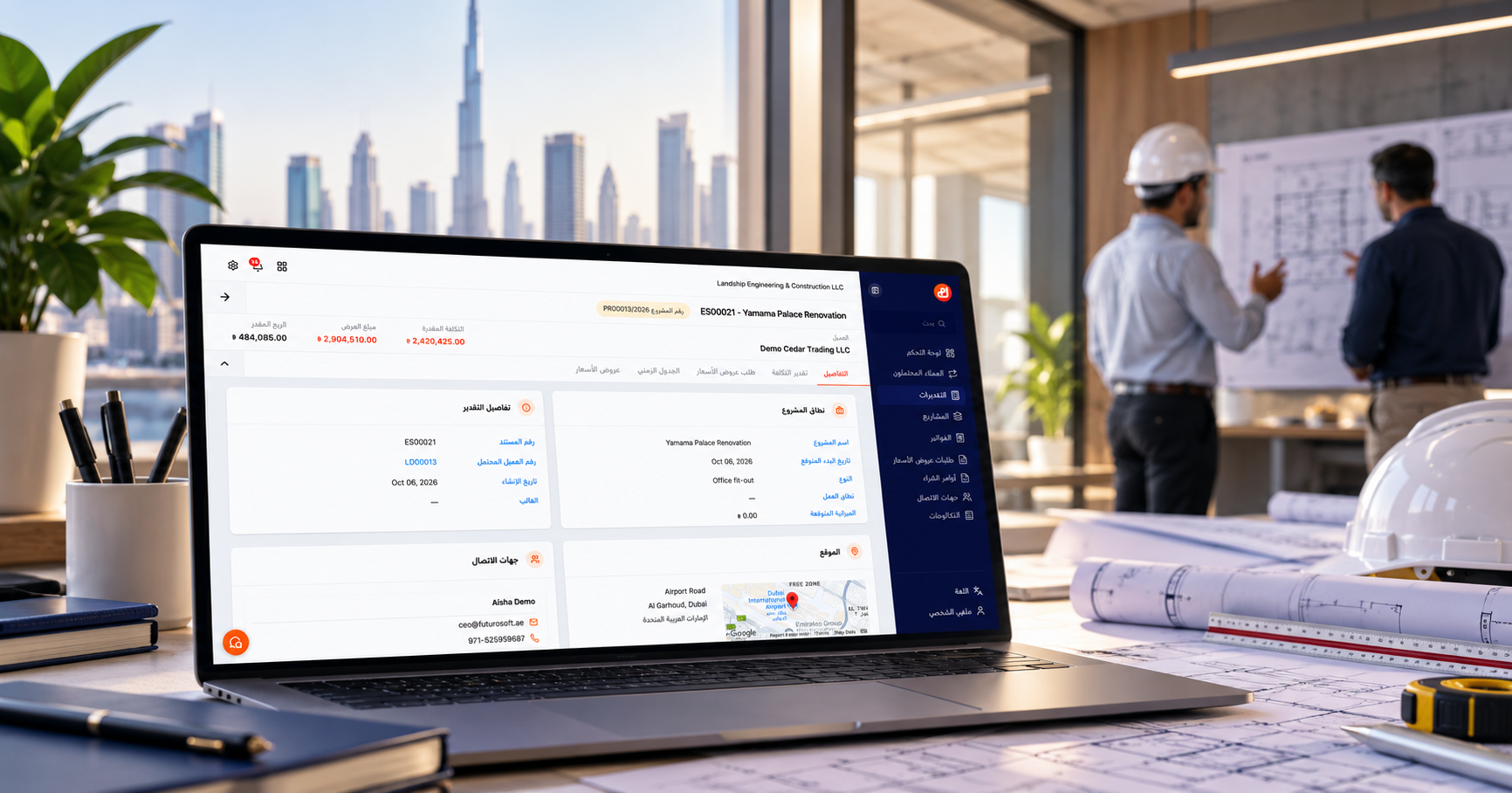
If you're running a construction business and looking for software, you've probably come across two common terms: Construction ERP and Construction Management Software.
At first, they might sound like the same thing, both help construction companies organize their operations. Both can manage costs, projects and business information and both promise to reduce manual work.
So, what's the difference? More importantly, which one does your construction business actually need? The answer depends on where your biggest problems are.
If your company struggles with accounting, payroll, financial reporting and managing business-wide resources, an ERP system may be worth considering.
But if your daily challenges involve project estimation, procurement, site progress, schedules and controlling execution costs, construction management software may be a better starting point.
Let's look at the differences without making things unnecessarily complicated.
1. What Is Construction ERP Software?
A Construction ERP is designed to manage several business functions through a connected system. Think of it as software that helps a construction company manage its overall business operations.
Depending on the system, it may include:
Accounting and financial management
Human resources and payroll
Procurement and supplier management
Inventory and warehouse management
Fixed assets and equipment
Project accounting and job costing
Business reporting and financial analysis
For example, imagine a construction company with 200 employees, several departments, multiple warehouses and projects running across different locations.
The finance department needs to manage accounts payable and receivable, HR handles salaries and employee records, Procurement manages suppliers and Management needs consolidated financial reports.
A Construction ERP can help connect these business functions. However, ERP systems vary considerably, some are primarily financial systems, while others include advanced construction project management capabilities.
2. What is Construction Management Software?
Construction management software focuses more directly on planning, coordinating and executing construction projects.
Instead of starting with the company's administrative functions, it starts with the project itself.
For example:
You receive an inquiry for an office fit-out project, your estimation team prepares the BOQ and quotation. Once the client approves it, the project manager creates the project schedule. The procurement team starts purchasing materials, Site engineers record daily progress, Management monitors project costs, budgets, and completion status.
Construction management software helps connect these activities.
Typical features include:
BOQ preparation and cost estimation
Quotation management
Project budgeting
Scheduling and task management
Procurement and purchase orders
Site diaries and daily progress reports
Labour, material, and equipment tracking
Variations and change orders
Project cost monitoring
The main objective is to help contractors manage projects more efficiently, improve coordination and protect project profitability.
ERP focuses on managing the business as a whole. Construction management software focuses on managing how projects are planned and delivered. There is overlap, and some products cover both areas.
3. Construction ERP vs Construction Management Software: Key Differences
Feature | Construction ERP | Construction Management Software |
|---|---|---|
Primary Focus | Business-wide operations | Project planning and execution |
Accounting & Finance | Usually comprehensive | Often limited or integrated |
HR & Payroll | Commonly available | Usually limited |
BOQ & Estimation | Depends on system | Common in contractor-focused solutions |
Project Scheduling | Varies by system | Commonly available |
Procurement | Business-wide purchasing | Project-related purchasing |
Site Progress Tracking | Depends on system | Usually a core feature |
Project Cost Control | Often through job costing | Often through execution budgets and cost tracking |
Inventory Management | Often comprehensive | Usually project-focused |
Implementation | Can be complex | Often simpler, depending on scope |
Best Suited For | Companies needing integrated enterprise operations | Contractors prioritizing project execution |
These are typical differences, not fixed rules. Some construction ERP platforms offer excellent project execution tools, and some construction management platforms include substantial financial and administrative functionality.
4. The Real Difference Becomes Clear During Project Execution
Let's take a practical example.
A fit-out contractor in Dubai wins a commercial renovation project worth AED 500,000. The estimated project cost is AED 400,000, leaving an expected profit of AED 100,000.
Once the project begins, several things happen.
Material prices increase, the client requests additional electrical work, the ceiling installation takes longer than expected and A subcontractor submits an additional claim.
Now the project manager needs answers. How much of the original material budget has been spent? How many purchase orders are still outstanding? What additional labour costs have been incurred? How much will the remaining work cost? Is the project still expected to make a profit?
A traditional accounting-focused ERP may help record purchase invoices, payments, and financial transactions. But recording expenses is only one part of controlling a construction project. The project manager also needs to understand the activities creating those expenses.
For example, a purchase order is not simply a financial transaction. It represents materials required for a particular project activity. A delay is not just a scheduling problem. It may increase labour, equipment, and overhead costs. An unapproved variation is not just additional work. It may become an expense the contractor cannot recover.
Construction management software is designed to make these project relationships easier to manage. That doesn't mean ERP cannot handle them, A construction-specific ERP with the appropriate modules may offer similar functionality.
The important question is whether your software supports the way your projects actually operate.
5. Why Accounting Software Alone May Not Be Enough
Many small and medium construction companies start with accounting software and Excel. And there's nothing wrong with that.
Accounting software helps businesses manage invoices, payments, taxes, financial statements and other accounting requirements. Excel is useful for estimates, BOQs, schedules and reports. But as the company grows, managing project operations through disconnected tools becomes difficult.
Imagine a situation, Your procurement team issues a purchase order for AED 25,000, the supplier delivers the materials, but the invoice hasn't arrived yet. Your accounting system may not yet reflect that amount as an expense. However, your company has already made a purchasing commitment.
If the project manager looks only at recorded expenses, the project may appear to have more budget available than it actually does. The same problem happens with subcontractor commitments, pending material purchases, and expected labour costs.
Accounting tells you what has been recorded financially. Project cost control also needs to consider what has been committed and what is still expected to be spent.
A well-configured construction ERP can provide this visibility too, but a basic accounting setup may not.
6. Which Software Is Better for Small and Medium Contractors?
For many small and medium construction contractors, the biggest challenge is not managing a complicated corporate structure. It's managing everyday project activities.
Consider a small MEP contractor with 25 employees. The company handles electrical installations, HVAC work, and plumbing projects. The owner may personally review quotations, approve material purchases, monitor project progress, and follow up on payments.
The business might already have an accounting system that works well. But project information is scattered across spreadsheets, WhatsApp messages, and paper reports.
In this situation, replacing the accounting system with a large ERP may not solve the most urgent problems. The company may benefit more from software that connects:
Estimation → Quotation → Project → Budget → Procurement → Site Progress → Cost Monitoring
That said, a company struggling with payroll, inventory, multiple legal entities, or consolidated financial reporting may have stronger reasons to prioritize ERP.
The best software is not necessarily the one with the most features. It's the one that solves the problems affecting your business today without creating unnecessary complexity.
7. When Does a Construction Company Need ERP?
ERP becomes particularly useful when business operations become difficult to manage across departments.
For example, your company may have:
Multiple branches or legal entities
Large employee and payroll requirements
Centralized procurement across many projects
Several warehouses and inventory locations
Complex financial reporting requirements
Multiple departments using disconnected administrative systems
In these situations, a centralized ERP can improve coordination and reporting. However, company size alone shouldn't determine the decision.
A small contractor with complex inventory requirements might need ERP earlier than a larger project-based company with relatively simple administrative processes.
The decision should be based on operational needs rather than employee count or revenue alone.
Masarek Editorial Team
Editorial team
Articles prepared by the Masarek team at Futurosoft Technologies FZCO, focused on practical construction management for GCC contractors.