
Construction Cost Estimation: Common Mistakes Contractors Make
Winning a construction project is important. But winning it at the wrong price can be an expensive mistake.
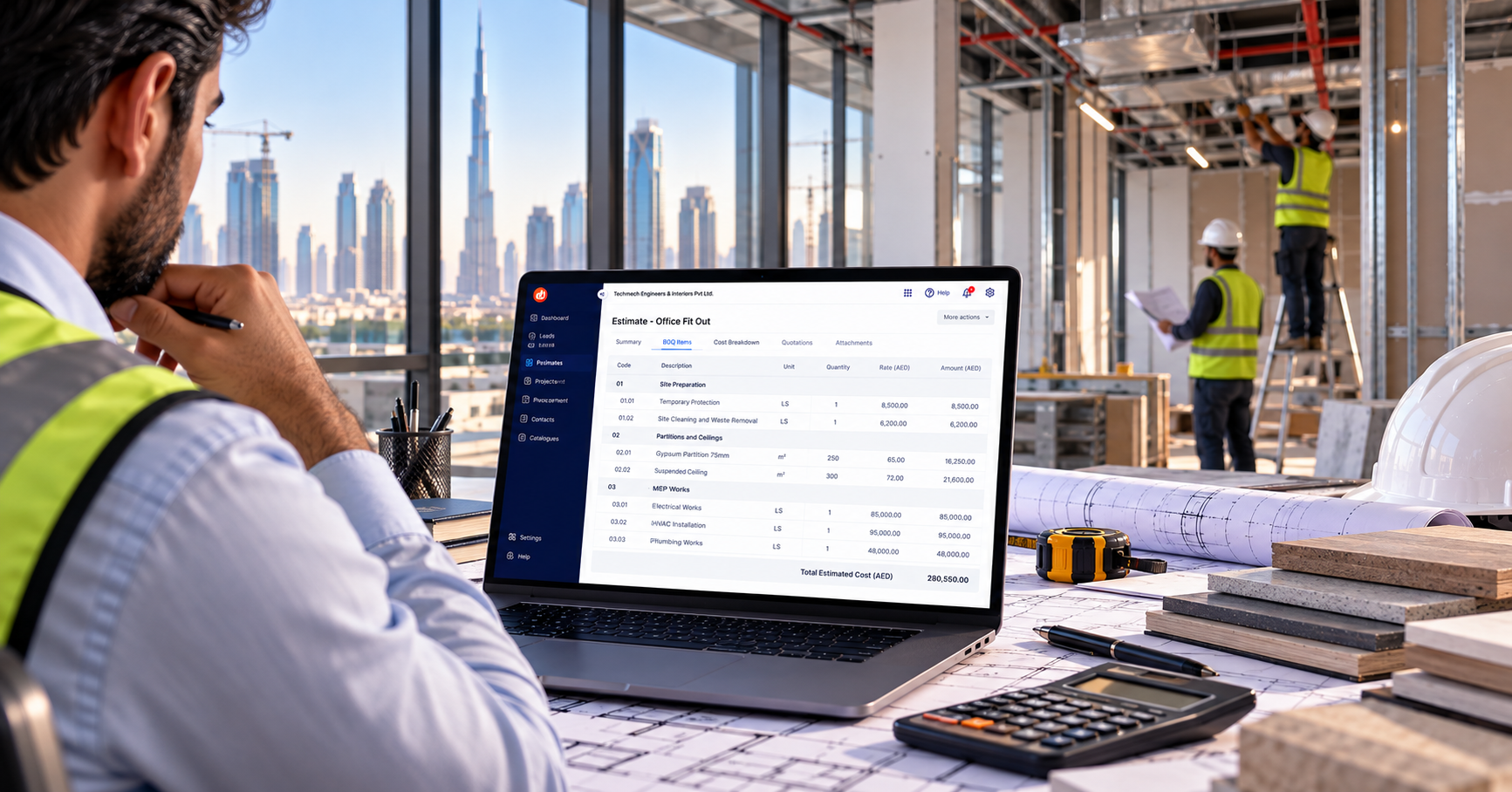
Imagine you've just won a commercial fit-out project in Dubai worth AED 500,000. Your team prepared the BOQ, collected supplier quotations, calculated labour costs and submitted a competitive offer.
Everything looks good. The client accepts your quotation and your project team starts working. A few weeks later, the problems begin.
Some materials cost more than expected, labour productivity is lower than planned, a few items were missed in the original estimate and the project manager discovers that certain subcontractor activities weren't included in the budget.
By the time the project reaches completion, your expected profit of AED 75,000 has almost disappeared.
What went wrong? The project may have been executed reasonably well, but the original cost estimate didn't accurately reflect what it would take to complete the work. This is a common challenge for construction contractors.
A profitable construction project starts with an accurate estimate but even a small estimation mistake can become a major financial problem during execution.
Let's look at ten common construction cost estimation mistakes and how contractors can avoid them.
1. Underestimating Material Costs
Material costs are one of the largest components of many construction projects. Yet contractors sometimes prepare estimates using outdated prices, previous project rates, or assumptions that haven't been verified with suppliers.
Consider a simple example. An MEP contractor estimates 3,000 metres of electrical cable at AED 18 per metre.
The estimated material cost is: 3,000 × AED 18 = AED 54,000
However, when the project begins, the actual purchase price is AED 21 per metre.
The actual material cost becomes: 3,000 × AED 21 = AED 63,000
That's an additional AED 9,000 on a single material item.
Now imagine similar differences across cables, pipes, fittings, insulation, equipment and other materials, the total impact can be substantial.
How to Avoid It
Use current supplier quotations when preparing estimates, especially for high-value materials. Maintain a regularly updated material price database and record the date and source of each rate.
For materials with volatile prices, consider quotation validity periods and appropriate contractual provisions.
Most importantly, don't assume that the purchase price from your last project will still be valid for the next one.
2. Missing BOQ Items
One of the most expensive estimation mistakes is forgetting to include necessary work.
This happens frequently in fit-out, MEP, and renovation projects, where many small activities contribute to the final cost.
For example, an office fit-out estimate might include gypsum partitions, painting, flooring, and ceiling installation.
But what about:
Surface preparation and protection
Access panels
Firestopping
Testing and commissioning
Waste removal
Temporary works
Material handling
Final cleaning and handover
Individually, some of these items may seem minor. Together, they can significantly affect project profitability.
The problem becomes worse when the contract is awarded on a lump-sum basis and the omitted activities are already part of the contractor's contractual scope.
How to Avoid It
Use standardized BOQ templates and estimation checklists based on your project type. Review drawings, specifications, scope documents, and site conditions before finalizing the estimate.
For complex projects, involve experienced engineers and site supervisors in the estimation review. A second review by someone who wasn't involved in preparing the original estimate can help identify omissions.
3. Using Incorrect Material Quantities
Even when material rates are accurate, incorrect quantities can create major cost differences.
Suppose you're estimating flooring for a commercial renovation project. The measured floor area is 1,000 square metres. You calculate the material requirement based on exactly 1,000 square metres.
But during execution, cutting, breakage, layout patterns, and site conditions result in additional material consumption.
If the actual requirement reaches 1,080 square metres, your original estimate is short by 80 square metres. At AED 65 per square metre, that's an additional AED 5,200.
And that's before considering any additional handling or installation costs.
How to Avoid It
Use reliable quantity takeoff methods. Apply appropriate waste allowances based on the material, installation method, and project conditions.
For example, tile wastage may differ depending on tile size, layout pattern, and room geometry.
Don't apply the same wastage percentage to every material. Where possible, verify critical quantities against drawings and site measurements.
4. Underestimating Labour Costs
Labour estimation is not simply multiplying the number of workers by their daily wages. Productivity matters just as much.
Imagine estimating that four technicians can complete an installation in ten working days.
Your estimated labour requirement is: 4 technicians × 10 days = 40 worker-days
But the actual installation takes 15 days because of restricted access, coordination issues, or lower-than-expected productivity.
The actual requirement becomes: 4 technicians × 15 days = 60 worker-days
That's a 50% increase in labour time. If the fully loaded labour cost is AED 200 per worker-day, your original labour estimate was AED 8,000, while the actual cost becomes AED 12,000.
An additional AED 4,000 may not seem significant on its own. But similar productivity issues across multiple activities can quickly consume your expected profit.
How to Avoid It
Estimate labour based on realistic productivity rates, not ideal working conditions.
Consider site access, working hours, project location, installation complexity, and coordination with other trades.
Review actual labour consumption from previous projects. Historical project data can help estimators understand how much time similar activities really require.
5. Ignoring Indirect and Overhead Costs
Some contractors focus heavily on direct material and labour costs while overlooking indirect project expenses.
These may include:
Site supervision
Temporary facilities
Transportation and logistics
Equipment rental
Permits and approvals
Insurance and guarantees
Site utilities
Safety requirements
Project administration
Testing and handover documentation
These costs are necessary to deliver the project, even though they may not be directly associated with a specific BOQ item.
Consider a project with direct costs of AED 300,000.
If indirect project costs amount to AED 25,000 but weren't included in the estimate, the expected profit is overstated by AED 25,000.
For smaller contractors working with narrow margins, that can be a serious problem.
How to Avoid It
Separate direct costs, project-specific indirect costs, and company overhead allocations.
Use an estimation structure that makes these expenses visible. Review the expected project duration carefully because many indirect costs increase when projects are delayed.
6. Not Considering Project Duration and Delays
Construction cost estimation and scheduling are closely connected.
A project that takes three months to complete may have very different costs from the same project taking five months.
Consider a fit-out project requiring a site supervisor, temporary facilities, and rented equipment. If these expenses cost AED 15,000 per month, a two-month extension could add AED 30,000 to project costs.
Some delays may be recoverable from the client under the contract. Others may be the contractor's responsibility. The important point is that time has a cost.
How to Avoid It
Prepare a realistic preliminary project schedule during estimation.
Identify activities that depend on client approvals, material lead times, subcontractors, and access restrictions. Estimate time-related expenses based on the expected duration.
Consider appropriate contingency allowances for identifiable risks rather than assuming every activity will proceed exactly as planned.
7. Relying Too Much on Previous Project Estimates
Using historical estimates can save time. But copying an old BOQ and changing a few quantities isn't always reliable.
Two projects may look similar but have very different requirements.
For example, two office fit-out projects may have the same floor area. However, one may require premium finishes, extensive MEP modifications, restricted working hours and complicated access arrangements.
The other may involve straightforward installation in an empty building. Using the same rates and productivity assumptions for both projects can produce misleading results.
How to Avoid It
Use previous estimates as references, not as final answers.
Compare project specifications, material quality, site conditions, schedules, and subcontractor requirements.
Most importantly, use actual costs from completed projects, not just their original estimates.
If a previous project was estimated at AED 400,000 but actually cost AED 450,000, repeating the original estimate without investigating the difference can repeat the same mistake.
8. Forgetting Subcontractor Scope Gaps
Subcontractor quotations can create unexpected costs when their scope is not clearly understood.
Imagine receiving an HVAC subcontractor quotation for AED 80,000. You include the amount in your estimate. After the project begins, you discover that the subcontractor's price excludes equipment lifting, access equipment, electrical connections, testing, or certain installation accessories.
Those costs may now fall on your company. The issue isn't necessarily that the subcontractor's quotation was incorrect. The problem is that the scope and exclusions weren't properly reviewed.
How to Avoid It
Compare subcontractor quotations against the full project scope.
Review inclusions, exclusions, quantities, specifications, payment terms, and responsibilities. Clarify any ambiguities before submitting the final quotation to your client.
For major subcontract packages, use a comparison sheet rather than selecting suppliers based only on the lowest price.
9. Confusing Markup With Profit Margin
This is a financial mistake that can directly affect quotation pricing. Markup and profit margin are not the same thing.
Suppose your estimated project cost is AED 400,000. You want a 20% profit margin.
If you simply add 20% to the cost: AED 400,000 × 1.20 = AED 480,000
Your expected profit is AED 80,000.
But your profit margin is: AED 80,000 ÷ AED 480,000 = 16.67%
You applied a 20% markup, not a 20% profit margin.
To achieve a 20% profit margin, the selling price should be: AED 400,000 ÷ (1 − 0.20) = AED 500,000
The difference is AED 20,000.
How to Avoid It
Make sure your estimation process clearly distinguishes between cost, markup, selling price, profit, and profit margin.
Use consistent calculation methods across all quotations. For larger projects, even a small percentage error can have a substantial financial impact.
10. Not Comparing Estimated Costs With Actual Project Costs
This may be the most damaging long-term mistake.
Many contractors prepare detailed estimates before winning a project. But once execution begins, the estimate is rarely reviewed again.
The procurement team purchases materials, site engineers record daily activities, the accounts department processes invoices.
At project completion, management checks whether the company made money.
But without comparing estimated costs against actual costs at the BOQ, activity, or cost-category level, it's difficult to understand what went wrong.
For example:
Cost Category | Estimated Cost | Actual Cost | Difference |
|---|---|---|---|
Materials | AED 180,000 | AED 195,000 | +AED 15,000 |
Labour | AED 100,000 | AED 118,000 | +AED 18,000 |
Subcontractors | AED 80,000 | AED 85,000 | +AED 5,000 |
Equipment & Other | AED 40,000 | AED 47,000 | +AED 7,000 |
Total | AED 400,000 | AED 445,000 | +AED 45,000 |
If the contract value was AED 500,000, the original expected profit was AED 100,000.
After these additional costs, the profit falls to AED 55,000, assuming the contract value remains unchanged. That's a 45% reduction in expected profit.
Without proper cost tracking, management may not recognize the problem until the project is nearly finished.
How to Avoid It
Connect your project estimates with execution records.
Track actual material purchases, labour consumption, subcontractor expenses and other costs against the approved budget. Review committed costs as well as expenses already incurred.
This helps identify potential overruns before they become final losses.
Why Construction Estimates Shouldn't End When the Project Begins
An estimate is more than a document used to win a contract. It should become the financial reference for project execution.
Once the client accepts the quotation, the estimated costs can help establish the project budget. From that point, procurement, labour usage, subcontractor costs and other expenses should be monitored against the budget.
This creates a continuous process:
Estimate → Quotation → Project Budget → Procurement → Site Execution → Actual Cost → Cost Review
When these activities are connected, estimators can learn from project execution. They can see which materials were underestimated, which activities required more labour and which indirect expenses were overlooked.
That knowledge can improve future quotations. Over time, this becomes one of the most valuable advantages a construction company can develop.
How Masarek Helps Contractors Improve Cost Estimation and Control
Masarek is construction project management software designed to help small and medium contractors manage estimation and project execution in one connected system.
Instead of preparing a BOQ in one spreadsheet, managing procurement through emails, and tracking project expenses somewhere else, contractors can organize these activities within Masarek.
Structured BOQ Estimation
Prepare estimates using organized BOQ groups, subgroups, and items. Record estimated quantities, rates, and costs to build a clearer picture of project requirements.
Quotations
Generate quotations from estimates and manage revisions before client acceptance.
Estimate-to-Project Workflow
Convert accepted quotations into projects, reducing the need to recreate project information manually.
Project Budgets
Establish project budgets and monitor costs during execution.
Procurement Management
Manage supplier RFQs, purchase orders, and material receipts linked to projects.
Site Diaries
Record daily activities, labour, materials, equipment and completed work.
Actual Cost Tracking
Track project expenses and compare actual costs with the planned budget.
These connected workflows help contractors understand how their original estimates compare with what is actually happening on-site.
The objective isn't just to prepare better quotations. It's to protect the profit you expected when you submitted them.
Final Thoughts
Construction cost estimation is not simply about calculating quantities and adding prices.
It requires understanding materials, labour, productivity, subcontractors, project conditions, schedules, and financial risks.
For small and medium construction contractors, accurate estimates are particularly important because one poorly priced project can affect the financial performance of the entire business.
But accurate estimation is only the beginning. The real advantage comes when contractors continue monitoring costs after the project starts.
By connecting estimates, budgets, procurement, site activities, and actual expenses, companies can identify problems earlier and make better decisions.
Winning a project at the right price is important. Keeping it profitable during execution is what makes the difference.
Masarek Editorial Team
Editorial team
Articles prepared by the Masarek team at Futurosoft Technologies FZCO, focused on practical construction management for GCC contractors.