
Construction Software UAE: 6 Solutions Compared for Contractors
Looking for construction software in Dubai, Abu Dhabi, or elsewhere in the UAE? We compare six solutions, their advantages, limitations, and the types of construction companies they suit best.
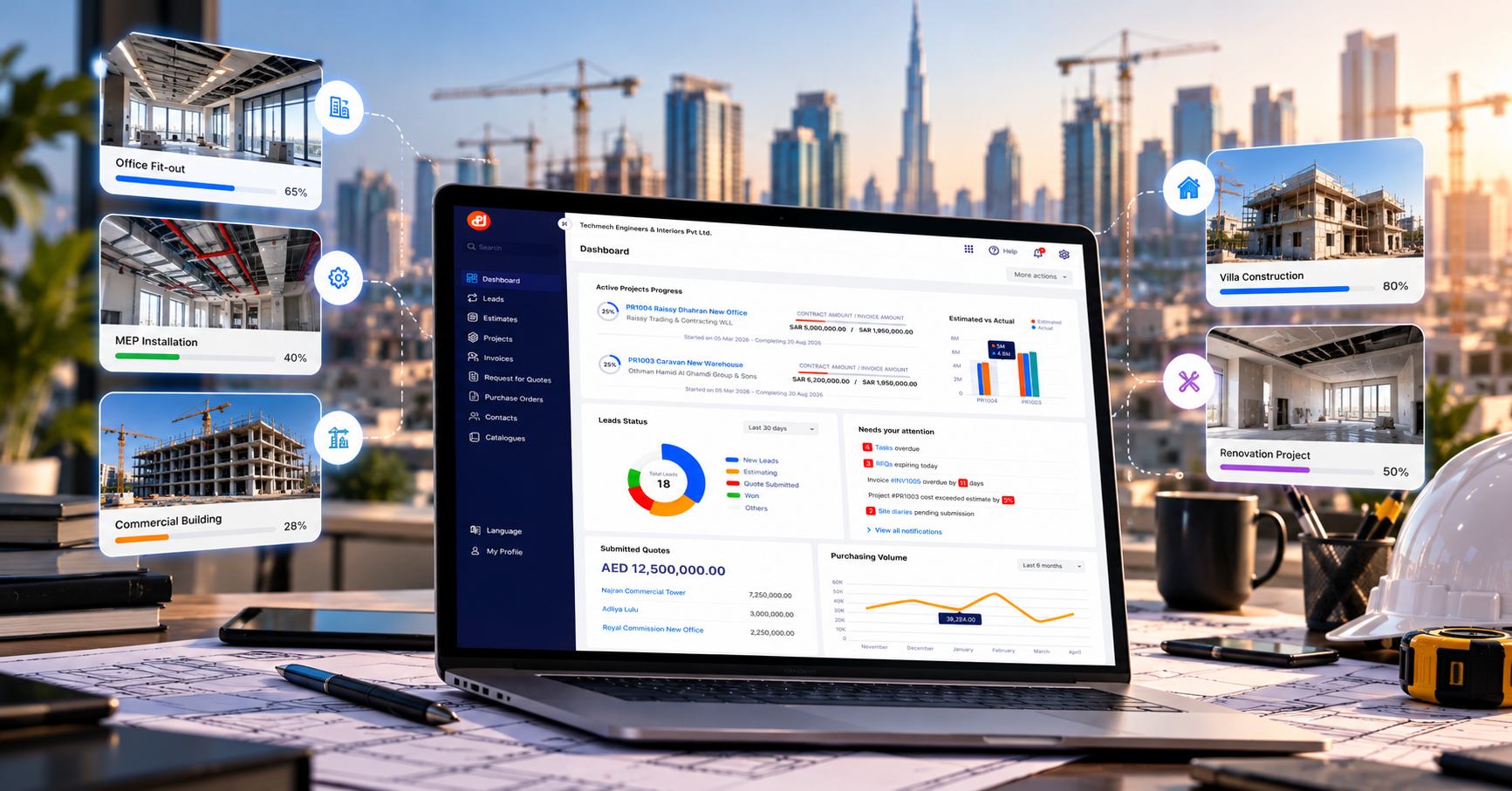
Choosing construction software isn't as straightforward as it sounds.
Search for "construction software UAE" and you'll find everything from full construction ERP systems to project management platforms, accounting solutions and mobile apps for site inspections.
They all promise to improve productivity but they don't necessarily solve the same problems.
A small fit-out contractor managing two projects has very different requirements from a large construction company with 500 employees, multiple warehouses and a dedicated finance department. Similarly, an MEP contractor struggling with BOQ estimation and material procurement may not need the same software as a consultant managing inspections and snagging.
So, rather than listing dozens of features, let's compare six construction software solutions available to UAE contractors and examine where each one makes sense.
Quick Comparison: Construction Software Available in the UAE
Software | Main Focus | Best Suited For | Pricing Approach |
|---|---|---|---|
Masarek | Estimation, procurement, project execution and cost control | Small and medium contractors | Per-user subscription |
First Bit ERP | Construction ERP, finance, HR, inventory and projects | Contractors needing integrated ERP | Custom quotation |
Odoo | Customizable business ERP | Companies needing accounting and operational modules | Per-user subscription plus implementation |
Procore | Construction project management and collaboration | Growing and larger contractors | Custom quotation |
PlanRadar | Site inspections, documentation and snagging | Site teams, consultants and contractors | Per-user subscription |
Autodesk Construction Cloud | Drawings, documents, coordination and construction workflows | BIM-intensive and multidisciplinary projects | Product-specific or custom pricing |
These solutions are not ranked by overall quality, they are compared by their suitability for different construction business requirements.
1. Masarek - Construction Project Management for Small and Medium Contractors
Website: https://masarek.com
Masarek is a UAE-based construction management platform designed around the activities contractors perform from receiving a lead to completing a project and issuing invoices.
Its focus is on connecting construction operations rather than replacing every administrative system in a business.
For example, a fit-out contractor can prepare an estimate, generate a quotation, convert the accepted quotation into a project, manage material procurement, record site progress, and monitor project costs.
This makes it relevant for companies that already have accounting software but need better control over project execution.
Key Features
Lead management and site visits
BOQ estimation and quotations
Project management and scheduling
Requests for quotations and purchase orders
Site diaries and progress tracking
Variations and change orders
Bills, expenses and invoicing
Actual quantity and cost tracking
Mobile application
English and Arabic interface
Pros
Construction-focused workflows: Instead of requiring contractors to adapt general-purpose software, Masarek is structured around estimating, procurement, site operations and project execution.
Suitable for smaller teams: Its SaaS model is intended to make construction management accessible without requiring a large ERP implementation.
Connected operational information: Estimation, quotations, projects and procurement can be managed within the same platform.
Regional relevance: The software is developed in the UAE and supports English and Arabic.
Transparent subscription model: Per-user licensing can make initial software costs easier to estimate.
Cons
Not a complete ERP replacement: Companies needing comprehensive general ledger accounting, payroll, advanced HR, or enterprise-wide financial consolidation may still require an ERP or accounting system.
Specialized enterprise requirements: Large contractors with complex custom processes may require enterprise implementation, integrations or additional customization.
Not primarily a BIM coordination platform: Companies needing advanced 3D model coordination should evaluate dedicated BIM solutions.
Pricing
Masarek offers SaaS subscriptions and an Enterprise option. Its published pages currently show different SaaS rates, so buyers should confirm the current per-user price, annual billing terms and applicable taxes.
Who Should Consider Masarek?
Masarek is worth evaluating for fit-out, MEP, renovation, small general contracting and specialized construction companies.
It is particularly relevant when the main challenge is controlling project operations rather than replacing an existing accounting system.
Best fit: A contractor with several active projects who wants to connect estimates, procurement, site progress and costs without implementing a full ERP.
2. First Bit ERP - Construction ERP for Financial and Operational Management
Website: https://firstbit.ae
First Bit is a construction-focused ERP solution with an established UAE presence.
Unlike software focused mainly on project execution, First Bit aims to connect construction operations with accounting, payroll, inventory, financial reporting and other business functions.
For example, a contractor operating several warehouses and managing a large workforce may want purchasing, stock movements, payroll and project accounting handled in one system.
First Bit is designed for this type of requirement.
Key Features
BOQ estimation and tendering
Project budgeting and cost control
Procurement and supplier management
Accounting and financial reporting
HR and payroll
Warehouse and inventory management
Equipment management
Project cash-flow management
UAE VAT and corporate tax accounting workflows
Multi-company accounting
Pros
Comprehensive ERP coverage: First Bit connects construction project activities with core administrative and financial processes.
Construction-specific financial control: BOQ estimation, project costing, purchasing and financial reporting are integrated.
UAE-focused functionality: The platform addresses local accounting, tax and payroll requirements.
Inventory and equipment management: Useful for contractors operating warehouses, equipment fleets or material-intensive projects.
Local implementation and support: A relevant advantage for companies needing substantial onboarding assistance.
Cons
Longer implementation: A comprehensive ERP normally requires more configuration, data preparation and staff training than a focused project management tool.
Potentially excessive for smaller contractors: Businesses that already have reliable accounting software may not need the entire ERP scope.
Implementation cost: Buyers need to evaluate customization, migration, training and ongoing support in addition to licensing.
Greater process discipline required: Teams must consistently record transactions across departments to benefit from the integrated system.
Pricing
Custom quotation. First Bit indicates that implementation commonly takes approximately two to six months, depending on requirements.
Who Should Consider First Bit?
Medium and larger contractors seeking one connected system for project management, accounting, HR, procurement and inventory.
Best fit: A contractor planning to replace disconnected administrative systems with a construction-specific ERP.
3. Odoo - Flexible ERP for Construction Businesses
Website: https://www.odoo.com
Odoo is a modular ERP platform used across many industries.
It isn't exclusively designed for construction, but its accounting, purchasing, inventory, CRM, HR and project management applications can support construction businesses.
With suitable configuration or customization, Odoo can be adapted to contractor workflows.
For example, a company might use Odoo for accounting, purchase orders, supplier management, employee records and project-related expenses.
However, construction-specific processes such as detailed BOQ estimation, variation management or specialized job costing may require additional development or third-party modules.
Key Features
Accounting and invoicing
CRM and sales
Procurement and purchasing
Inventory management
Project management
HR applications
Timesheets and expenses
Reporting and customization
Pros
Flexible architecture: Companies can implement the applications they need and expand over time.
Broad business functionality: Suitable for businesses wanting more than construction project management.
Extensive customization ecosystem: Implementation partners and third-party applications can adapt Odoo to specialized requirements.
Published subscription pricing: Standard software licensing is relatively easy to compare.
Cons
Not construction-specific out of the box: Important contractor workflows may need configuration or custom modules.
Implementation quality varies: The experience depends heavily on the implementation partner and the design of the solution.
Customization adds cost: A low initial subscription price doesn't necessarily mean a low total project cost.
Maintenance considerations: Custom modules may require ongoing support when upgrading the system.
Pricing
Odoo publishes Standard and Custom per-user subscription plans, with annual and monthly billing options. Implementation, customization and certain hosting arrangements can add costs.
Who Should Consider Odoo?
Construction businesses that want a flexible ERP and are willing to invest in configuration.
Best fit: A company seeking accounting, inventory, purchasing and general business management in one customizable platform.
4. Procore - Construction Project Management for Complex Collaboration
Website: https://www.procore.com
Procore is an established construction management platform focused on connecting project teams and managing construction delivery.
Its capabilities span project coordination, documentation, financial workflows, quality, safety and reporting.
Procore is particularly relevant when a project involves many stakeholders, including owners, consultants, general contractors and subcontractors.
Key Features
Project management and collaboration
Drawings and document control
RFIs and submittals
Construction financial workflows
Quality and safety management
Site documentation
Project reporting
Integrations with other business systems
Pros
Broad project management capabilities: Suitable for coordinating complex construction activities.
Stakeholder collaboration: Helps multiple organizations work with shared project information.
Document control: Valuable where drawings, approvals and revisions need careful management.
Integration ecosystem: Can connect with other construction and financial tools.
Cons
May be more than small contractors need: A business managing a few small fit-out projects may not require its full scope.
Commercial evaluation required: Pricing is generally quotation-based, making direct comparison less straightforward.
Training and adoption: Larger platforms require teams to learn and consistently follow structured workflows.
Accounting may still be separate: Buyers should verify how their financial system will integrate.
Pricing
Custom quotation based on requirements.
Who Should Consider Procore?
Growing general contractors, larger subcontractors and organizations coordinating complex projects with many participants.
Best fit: A contractor whose primary challenge is managing project collaboration, documentation and execution across multiple stakeholders.
5. PlanRadar - Site Inspections, Snagging and Documentation
Website: https://www.planradar.com/ae-en
PlanRadar focuses on construction site documentation, inspections, task tracking and issue management.
It is particularly useful for teams that need to record observations directly against drawings and share updates with colleagues or subcontractors.
For example, during the handover of a commercial fit-out project, a site engineer can record defects, attach photos, assign responsibilities and track corrective actions.
Key Features
Digital site inspections
Snagging and defect tracking
Drawing-based issue management
Photo documentation
Task assignments
Inspection reports
Checklists and forms
Mobile access
Pros
Strong site documentation focus: Useful for inspection-heavy projects.
Structured snagging: Helps organize defects and follow-up actions.
Mobile workflows: Site teams can record issues directly from the project location.
Clear accountability: Tasks and observations can be assigned and tracked.
Cons
Not a complete construction ERP: It doesn't replace comprehensive accounting, payroll and enterprise financial management.
Limited fit for BOQ-to-procurement workflows: Contractors seeking an integrated estimating, quotation, purchasing and cost-control process should verify whether it meets their requirements.
Subscription costs can increase: Costs depend on the plan, user count and required capabilities.
Pricing
PlanRadar publishes subscription tiers and an Enterprise option. Buyers should check the UAE pricing page for current rates and billing terms.
Who Should Consider PlanRadar?
Site engineers, quality teams, consultants, fit-out contractors and property-related teams managing inspections and handovers.
Best fit: A business whose main challenge is documenting, assigning and resolving site issues.
6. Autodesk Construction Cloud — Document and Model-Centric Construction Management
Website: https://construction.autodesk.com
Autodesk Construction Cloud is a family of construction products and workflows, including capabilities for document management, design collaboration, model coordination and construction project delivery.
It is especially relevant to companies working with BIM models, large drawing sets and multiple design disciplines.
For example, a major MEP project may involve architectural, structural, electrical, mechanical and plumbing models that need to be coordinated before installation.
Autodesk's construction solutions can help teams manage these information-heavy processes.
Key Features
Construction document management
Drawing and revision control
Design collaboration
BIM model coordination
Issue tracking
Construction workflows
Field management capabilities
Integration with Autodesk design tools
Pros
Strong design-to-construction workflows: Particularly valuable for companies using Autodesk design products.
BIM coordination: Useful for projects involving multiple engineering disciplines.
Document management: Helps control drawings and revisions across project participants.
Scalability: Relevant for complex construction projects and larger teams.
Cons
Different products serve different purposes: Buyers must identify which Autodesk tools are actually required.
Can be complex for small contractors: A simple renovation business may not need extensive BIM and document coordination capabilities.
Additional training: Effective implementation may require BIM or digital construction expertise.
Cost varies by configuration: The final subscription and implementation cost depends on selected products and requirements.
Pricing
Varies by product, licensing arrangement and commercial agreement.
Who Should Consider Autodesk Construction Cloud?
Design-and-build contractors, BIM-focused MEP contractors, consultants and larger construction teams working with complex models and documentation.
Best fit: A company whose main challenge is coordinating designs, models, drawings and multidisciplinary construction information.
Construction Software UAE: Pros and Cons at a Glance
Software | Biggest Advantage | Main Limitation |
|---|---|---|
Masarek | Connected contractor workflows from estimation to project execution | Not a full accounting and HR ERP |
First Bit | Integrated construction operations, accounting, payroll and inventory | Greater implementation effort |
Odoo | Flexible ERP with broad business modules | Construction-specific customization may be needed |
Procore | Extensive project collaboration and documentation | May be excessive for smaller teams |
PlanRadar | Site inspections, snagging and issue tracking | Not a complete estimating and financial management solution |
Autodesk Construction Cloud | BIM, drawings and design coordination | May be unnecessarily complex for simpler projects |
Which Construction Software Is Best for Your Company?
There isn't one correct answer for every contractor. A more useful approach is to choose based on the problem you're trying to solve.
If You Run a Small Fit-Out Company
Your priorities may include estimating, quotations, purchase orders, project budgets, site progress and variations. Consider: Masarek.
If site snagging and handover documentation are particularly demanding, PlanRadar may also be worth evaluating.
If You Run an MEP Contracting Business
You may need detailed material estimates, purchasing controls, labour coordination and project cost tracking. Consider: Masarek for project operations, First Bit for broader ERP requirements, and Autodesk tools if BIM coordination is central to your work.
If You Need Accounting, HR and Warehouse Management
If you manage multiple warehouses, payroll, inventory, financial reporting and construction projects, a comprehensive ERP may be more appropriate. Consider: First Bit or a properly configured Odoo implementation.
If You Manage Large Construction Projects
If your company coordinates multiple consultants, subcontractors and stakeholders, document control and collaboration may become priorities. Consider: Procore or relevant Autodesk Construction Cloud products.
If Your Biggest Problem Is Site Inspections
If you need to manage defects, inspections, snag lists and handover reports, a specialized site management solution may be sufficient.
Consider: PlanRadar.
Final Verdict: Which Construction Software Should UAE Contractors Choose?
If you're a small or medium contractor in the UAE, don't start by looking for the software with the most modules.
Start with the problems affecting your projects.
If your biggest challenges are BOQ estimation, quotations, procurement, site progress and project cost control, evaluate a construction-focused solution such as Masarek.
If you need accounting, payroll, inventory, financial reporting and project management together, evaluate a construction ERP such as First Bit.
If you want a customizable business ERP, Odoo may be suitable with the right implementation.
If you're managing complex projects involving multiple stakeholders, Procore is worth considering.
If your work involves site inspections, snagging and handover documentation, PlanRadar may be a strong fit.
If your company depends heavily on BIM coordination, design collaboration and drawing management, Autodesk Construction Cloud deserves consideration.
The best construction software is not the most expensive or the most popular.
It's the software that solves your actual problems, fits your team's working style, and helps you manage projects more profitably.
Looking for a Simpler Way to Manage Construction Projects in the UAE?
Masarek helps fit-out, MEP, renovation and specialized contractors manage their construction operations from estimation to execution.
Bring BOQs, quotations, project budgets, procurement, schedules, site diaries and project costs into one connected system.
Masarek Editorial Team
Editorial team
Articles prepared by the Masarek team at Futurosoft Technologies FZCO, focused on practical construction management for GCC contractors.
Related articles
Managing Multiple Construction Projects in the GCC
Running one construction project is challenging enough. Managing five or ten at the same time is a completely different story.
Masarek Editorial Team11 min read
Read article