
Managing Multiple Construction Projects in the GCC
Running one construction project is challenging enough. Managing five or ten at the same time is a completely different story.
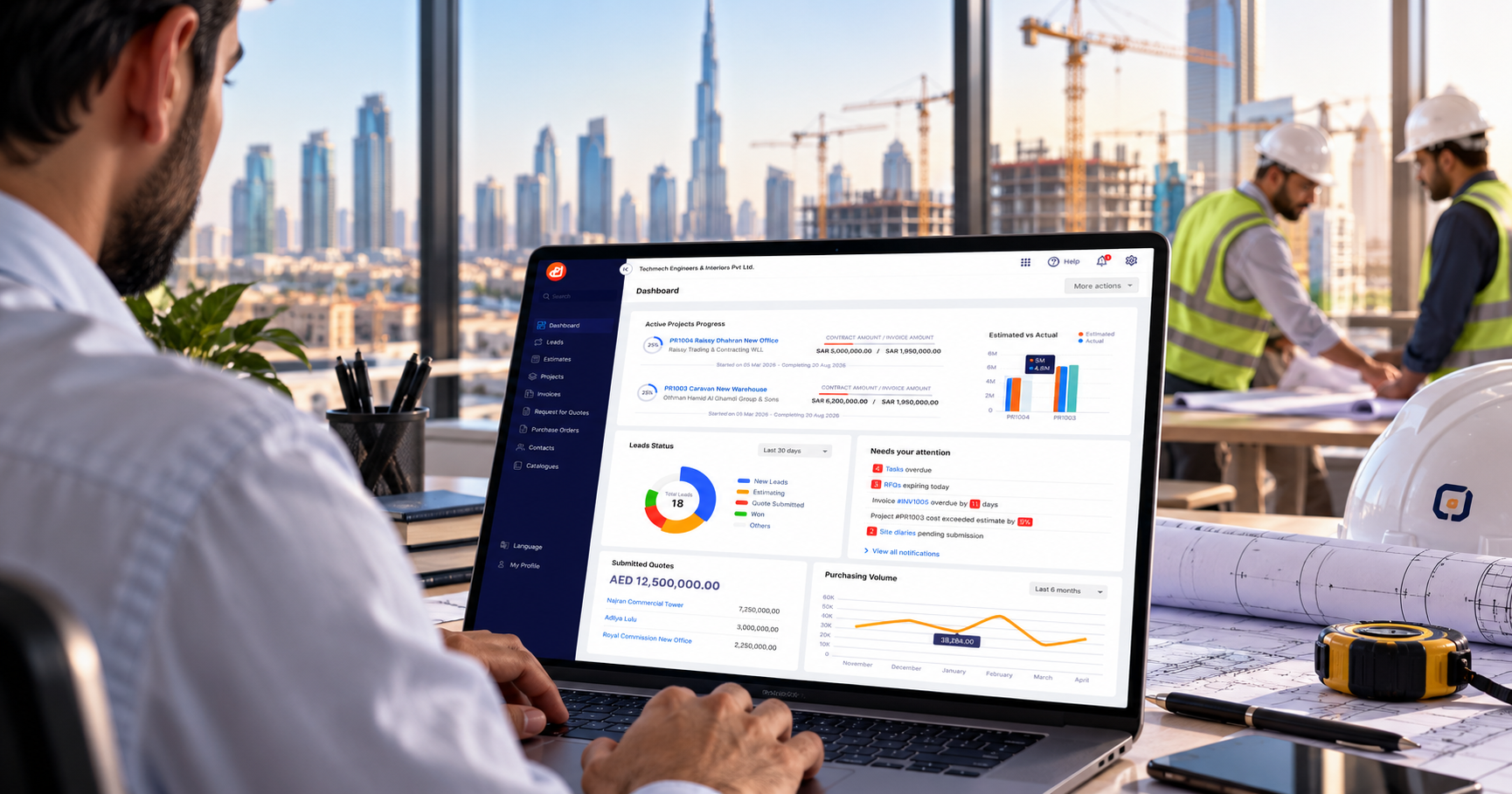
For a growing construction company, winning more projects is usually good news. Your business is expanding, new clients are coming in, your team is getting busier and opportunities are opening up.
But there's a problem many contractors discover only after they start growing.
More projects don't automatically mean more profit.
You might have three fit-out projects running in Dubai, two MEP installations in Abu Dhabi, and another commercial renovation project about to start.
Every project has its own deadlines, budgets, suppliers, subcontractors and site teams.
One project needs urgent materials. Another is waiting for client approval. A third is falling behind schedule. Meanwhile, your accounts team is following up on payments, and your procurement team is handling purchase requests from different sites.
Suddenly, you're spending more time chasing information than actually managing your business.
This is a familiar situation for many small and medium construction contractors across the Gulf Cooperation Council (GCC), including the UAE, Saudi Arabia, Qatar, Oman, Bahrain, and Kuwait.
So, how do you manage multiple construction projects without losing control of your costs, teams, and deadlines?
It starts with changing how project information is organized.
1. The Biggest Challenge Isn't the Number of Projects
Let's say your company manages six construction projects. Each project has a project manager, site engineer, supervisor, and workers.
On paper, the responsibilities are clear. But when you want to know what's happening across all six projects, where do you get the information? You might call each project manager. One sends an Excel report, another shares site photos on WhatsApp and third says the updated schedule will be ready tomorrow.
The procurement team has its own purchase order records, while the accounts department has a separate list of expenses. By the time you collect everything, some of the information may already be outdated.
The real problem isn't necessarily that you're managing too many projects. It's that every project is being managed as a separate island.
When information is scattered across different people, files, and communication channels, getting a clear picture of the business becomes difficult and as the number of projects increases, the problem gets worse.
2. Every Project Needs Its Own Budget
One of the most common mistakes growing contractors make is looking at the company's overall financial position without closely monitoring individual project costs.
Imagine your company has three active projects.
Project | Contract Value | Estimated Cost | Expected Profit |
|---|---|---|---|
Office Fit-Out — Dubai | AED 500,000 | AED 400,000 | AED 100,000 |
MEP Installation — Abu Dhabi | AED 350,000 | AED 290,000 | AED 60,000 |
Commercial Renovation — Dubai | AED 250,000 | AED 200,000 | AED 50,000 |
Total | AED 1,100,000 | AED 890,000 | AED 210,000 |
Looking at these numbers, your company expects to earn AED 210,000. But what if the first project exceeds its estimated cost by AED 80,000? What if the second project faces an additional AED 30,000 in labour expenses?
Suddenly, your expected combined profit falls from AED 210,000 to AED 100,000, assuming revenue remains unchanged. And if you're only reviewing company-wide expenses, you may not immediately understand which projects are consuming your margins.
This is why every project needs a separate budget.
You should be able to see how much was estimated, how much has been spent, what has already been committed, and how much is expected to be spent before completion.
A company can be busy, generate substantial revenue, and still struggle financially because individual projects are not profitable.
3. Centralize Procurement Without Losing Project-Level Control
Procurement becomes more complicated when several projects are running simultaneously.
Imagine three project managers requesting materials on the same day. One needs electrical cables, another needs gypsum boards and the third urgently requires plumbing fittings.
Your procurement team has to check suppliers, compare quotations, issue purchase orders, arrange deliveries and coordinate with site teams.
Now imagine doing all this through WhatsApp messages, phone calls and separate spreadsheets. It's easy for things to go wrong.
Materials might be ordered twice, a purchase request may be forgotten or an urgent order may be placed without checking the remaining project budget. A better approach is to centralize the procurement process while keeping every purchase connected to its project.
For example, a purchase order for electrical cables should clearly identify which project needs them, the approved quantity, the expected cost, and the supplier. This makes it easier to track commitments and understand where money is being spent. It can also help procurement teams identify opportunities to negotiate better prices when multiple projects require similar materials.
However, bulk purchasing should still consider storage, delivery timing, cash flow, and project-specific specifications.
4. Don't Depend on Phone Calls to Know Site Progress
A common question construction business owners ask their project managers is:
"What's the progress at the site?", The answer is often something like: "Almost 70% completed."
But what does 70% actually mean?, Does it mean 70% of the tasks are finished?, Does it mean 70% of the contract value has been completed? Or is it simply an approximate assessment?
When managing multiple projects, inconsistent progress reporting makes comparisons difficult. One project manager may calculate progress based on completed quantities, while another estimates progress visually.
To avoid confusion, every project should follow a consistent reporting method. For example, you can track progress against planned activities, measurable quantities, milestones, or appropriately weighted tasks.
Daily site reports can capture completed work, labour deployment, material usage, equipment, delays, and other relevant information. The objective isn't to make site engineers spend more time preparing reports. It's to make the information they already collect more useful.
You should be able to understand the status of your projects without calling every site manager individually.
5. Resource Planning Becomes Critical as You Grow
When a company manages one or two projects, allocating workers and equipment is relatively straightforward.
But when several projects are running simultaneously, resource conflicts become common. Consider a small MEP contractor with two experienced HVAC technicians.
Project A needs both technicians for installation work. At the same time, Project B requires them for testing and commissioning. Both project managers consider their work urgent. Without proper coordination, one project may be delayed.
The same situation can happen with supervisors, electricians, equipment, vehicles, and specialized subcontractors. This is why resource planning becomes increasingly important as your company grows.
You need to understand which resources are assigned to each project, when they will be available, and whether upcoming activities require additional support.
Even a simple shared resource plan can prevent unnecessary delays and improve productivity.
Masarek Editorial Team
Editorial team
Articles prepared by the Masarek team at Futurosoft Technologies FZCO, focused on practical construction management for GCC contractors.